

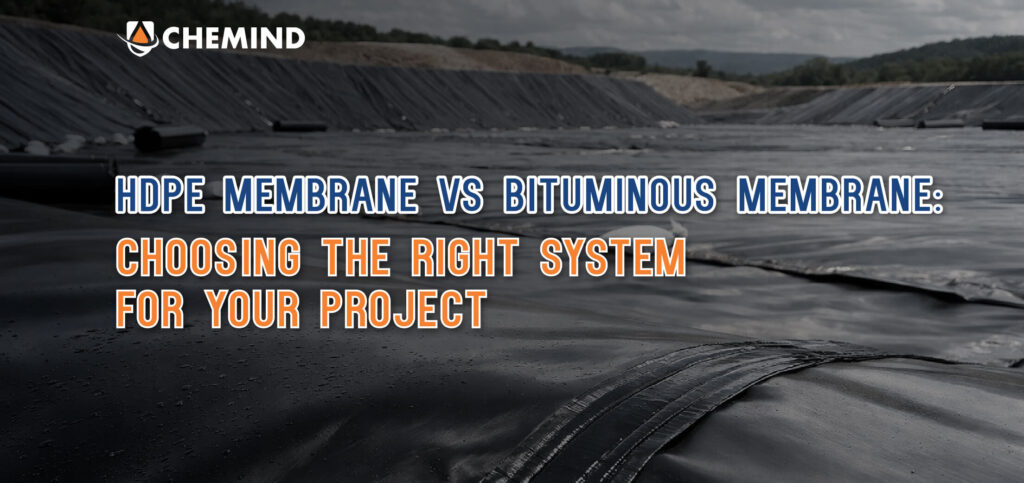
If you have spent any time in construction — whether you are a developer, engineer, or contractor — you already know the moment of tension that arrives when the specification sheet lands on your desk and two words stare back at you: HDPE or Bituminous. Both are proven systems. Both are widely used across Malaysia and the Asia Pacific. But choosing the wrong one for your specific site conditions can mean costly callbacks, voided warranties, and unhappy clients.
At Chemind Industries, we have been navigating exactly this decision for over 38 years. From deep basement slabs in Kuala Lumpur to sun-baked RC rooftops in Penang, we have seen both systems perform brilliantly — and both fail catastrophically — depending on where and how they were applied. This guide distils that field experience into one clear, practical resource.
We are not going to tell you one membrane is “better” than the other. What we will do is give you the technical framework to make the right call for your project.
Understanding the Two Systems
What Is an HDPE Waterproofing Membrane?
High-Density Polyethylene (HDPE) membranes are pre-formed, rigid-yet-flexible sheet systems manufactured from one of the most chemically inert polymers available. They form a physical barrier that water simply cannot penetrate — not by absorption, not by capillary action, not by chemical degradation.
In Malaysia, HDPE membranes are the system of choice for below-grade structures: deep basements, underground car parks, tunnel linings, pile caps, retaining walls, and any application where hydrostatic pressure is sustained and aggressive. The pre-applied method — where the membrane is laid on the blinding concrete before the structural slab is poured — creates a fully bonded system that prevents water migration at the membrane-to-concrete interface, even if a localised puncture occurs.
What Is a Bituminous Waterproofing Membrane?
Bituminous (asphalt-based) membranes have been the backbone of the waterproofing industry for over a century — and for good reason. Modified bitumen systems, particularly SBS (Styrene-Butadiene-Styrene) and APP (Atactic Polypropylene) variants, deliver outstanding performance on exposed and semi-exposed surfaces.
SBS-modified membranes are reinforced with synthetic rubber polymers that give them high elasticity — critical for accommodating structural movement in rooftops and elevated slabs. APP-modified membranes are stiffer and perform exceptionally under sustained UV exposure and high-temperature environments, which is why they remain a default specification for Malaysian RC rooftops.
Installation is typically torch-applied (for SBS and APP torch grades) or cold self-adhesive (for certain APP grades), and the two-layer built-up system provides an inherent redundancy that single-layer systems cannot match.
Head-to-Head: Key Technical Differences
The table below is a working reference you can bring to your next specification meeting.
| Criteria | HDPE Membrane | SBS Bituminous | APP Bituminous | Best Choice |
|---|---|---|---|---|
| Chemical Resistance | Excellent | Moderate | Moderate | HDPE |
| Flexibility / Movement | High | High (SBS) | Moderate | HDPE / SBS |
| UV Resistance | Excellent | Good (granules) | Good (granules) | HDPE |
| Installation Method | Mechanical / Adhesive | Torch-applied | Torch / Cold-applied | Situational |
| Cost (Upfront) | Higher | Moderate | Moderate | Bituminous |
| Lifespan | 50+ years | 20–30 years | 20–30 years | HDPE |
| Malaysia Suitability | High (below-grade) | High (rooftop) | High (rooftop) | Application-specific |
The Malaysia Factor: Why Local Conditions Change Everything
Malaysia’s climate is not just “hot and wet”. It is persistently, aggressively tropical — with average annual rainfall exceeding 2,500 mm in most urban centres, surface temperatures frequently hitting 55°C on exposed rooftops, and humidity levels that accelerate material degradation across the year.
These conditions impose very specific demands on waterproofing systems:
4. Insufficient Overlapping
Proper overlapping of membrane sheets is vital to create a watertight seal. Insufficient overlap can result in weak spots and potential leaks. Ensure that each sheet overlaps the previous one by at least 75-100 mm. Pay special attention to the edges and corners, where leaks are most likely to occur.
- UV degradation is constant. Exposed bituminous membranes without a granulated cap sheet or UV-protective coating will oxidise and crack within 5–7 years in Malaysia.
- Thermal cycling is severe. The roof surface expands and contracts daily by 3–5 mm on a typical 10m slab. SBS membranes, with their rubber-polymer modification, handle this movement far better than APP or rigid coatings.
- High water table is common. Many KL and Selangor sites sit at or near groundwater level. In these conditions, HDPE’s impermeability and hydrostatic pressure resistance is non-negotiable.
- Tropical vegetation is aggressive. Planter boxes and green roofs require a root-resistant barrier — HDPE’s density and chemical stability make it the standard recommendation.
Installation Process: What You Need to Know
HDPE Membrane Installation
Pre-applied HDPE installation is a sequenced, precision process. The membrane is laid on the blinding concrete or lean-mix with the adhesive side face-up, ready to bond with the fresh structural concrete poured directly on top. Seams are heat-welded or mechanically fastened depending on system specification. The result is a fully bonded, integrated system where the structural concrete and the membrane act as one.
Key installation requirements:
- Surface must be clean, dry, and level to within ±5mm tolerance
- Seam overlaps at minimum 100mm, heat-welded and tested with a probe
- Terminations and penetrations require reinforcement patches — this is where most failures originate on non-specialist installs
- Concrete pour must follow within the timeframe specified by the adhesive system
Bituminous Membrane Installation
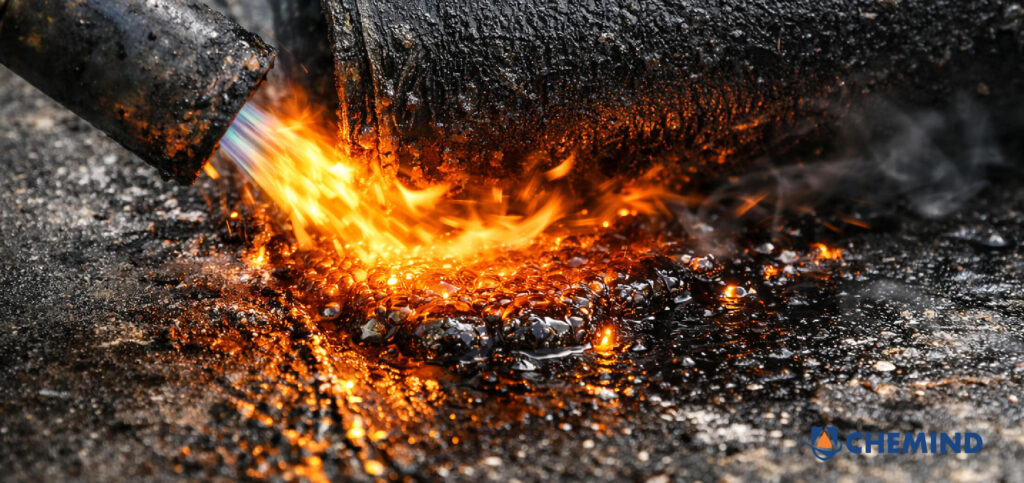
Torch-applied bituminous installation requires a skilled, gas-torch-certified applicator. The membrane underside is heated until the bitumen compound melts and bonds to the primed substrate. Seams are lapped and torch-sealed. A two-layer system — base sheet plus cap sheet — is the standard specification for any warranty-backed installation.
Key installation requirements:
- Concrete substrate must be primed with bituminous primer and allowed to cure fully (typically 2–4 hours in Malaysian conditions)
- Surface temperature must not exceed 60°C at the time of application
- Fire safety protocols are mandatory — torch-applied work on occupied buildings requires a hot-work permit
- Cap sheet with mineral granule finish provides UV protection and must face skyward
Which System Is Right for Your Project?
Use this quick-reference guide. If your project scenario falls into one of these categories, the recommendation reflects both Chemind’s field experience and industry best practice for Malaysian construction conditions.
| Your Project Scenario | Recommended System |
|---|---|
| Deep basement / underground structure | HDPE Pre-applied Membrane |
| Basement with structural movement | SBS Bituminous or HDPE |
| Retaining walls & planter boxes | HDPE |
| Bridge decks / car parks | HDPE or SBS Bituminous |
| Budget-sensitive rooftop projects | APP Bituminous Membrane |
| Chemically aggressive soil | HDPE Membrane (chemical-resistant grade) |
Still unsure? That is exactly what our free technical consultation is designed for. Send us your project brief and our waterproofing specialists will specify the right system — and the right product from our range.