

High-rise buildings are designed to move. Thermal expansion, wind loads, structural deflection, shrinkage, and seismic activity constantly place stress on a building’s joints and interfaces. Among the most vulnerable areas in any tall structure are expansion joints — and when waterproofing around these joints is poorly designed or improperly installed, leakage problems often become inevitable.
In many commercial and residential high-rise projects across Malaysia, expansion joint leakage is one of the most recurring waterproofing failures. The issue is rarely caused by a single product alone. Instead, it usually stems from specification gaps, incompatible materials, insufficient movement allowance, or incorrect detailing during installation.
At Chemind Industries, we understand that waterproofing expansion joints requires more than simply applying a membrane over a gap. It demands a complete system approach that considers structural movement, environmental exposure, substrate conditions, and long-term durability.
This article analyzes common patterns found in leading industry resources on expansion joint waterproofing and highlights the mistakes engineers and project teams frequently overlook.
Why Expansion Joints Are Critical in High-Rise Buildings
Expansion joints are intentional separations designed to accommodate building movement safely without causing structural cracking or stress concentration. These joints can be found in:
- Podium decks
- Roof slabs
- Basement structures
- Facades
- Parking decks
- Wet areas
- Long structural spans
- Connections between building blocks
Without proper movement accommodation, buildings may experience cracking, membrane failure, concrete deterioration, or water ingress over time.
In tropical climates like Malaysia, waterproofing expansion joints becomes even more challenging due to:
- High UV exposure
- Heavy rainfall
- Humidity
- Frequent thermal cycling
- Ponding water on horizontal surfaces
These conditions place constant stress on waterproofing systems, especially at movement joints.
What Engineers & Architects Often Get Wrong About Expansion Joint Waterproofing
1. Treating Expansion Joints Like Standard Cracks
One of the most common mistakes is assuming expansion joints can be waterproofed using ordinary crack repair methods or rigid cementitious systems.
Expansion joints are designed to move continuously. Applying rigid materials over active joints eventually leads to:
- Adhesion failure
- Membrane tearing
- Delamination
- Water seepage
Many failures occur because the waterproofing system lacks sufficient elasticity or movement accommodation capability. Industry guidelines consistently emphasize the importance of flexible waterproofing systems and reinforced detailing around expansion joints.
Waterproofing solutions for movement joints are selected based on anticipated movement, substrate conditions, and exposure environment — not simply by product availability.
2. Ignoring Actual Joint Movement Calculations
Another major issue is underestimating how much a high-rise building actually moves.
Movement occurs due to:
- Thermal expansion and contraction
- Wind sway
- Live loads
- Concrete shrinkage
- Creep
- Differential settlement
Some projects use generic joint widths without calculating real movement expectations. This can cause premature failure when the waterproofing system exceeds its movement capability.
According to industry references, expansion joint systems must be selected according to total expected movement percentage, not just visible joint width.
Proper design coordination between structural engineers and waterproofing specialists is essential from the early stages of the project.
3. Poor Compatibility Between Waterproofing Materials
Not all waterproofing materials are compatible with expansion joint sealants, tapes, primers, or adjacent membranes.
This is a common problem when multiple subcontractors use different systems without proper coordination.
Potential failures include:
- Chemical incompatibility
- Adhesion loss
- Softening or hardening of sealants
- Separation at interfaces
For example, certain membranes may not bond properly with polyurethane sealants or EPDM joint systems unless the correct primer and detailing method are used.
Successful expansion joint waterproofing requires system compatibility testing and proper detailing integration.
4. Insufficient Reinforcement at Critical Joint Areas
Expansion joints are high-stress zones. Yet in many projects, reinforcement layers are skipped to reduce costs or installation time.
Leading waterproofing references consistently recommend reinforcement at movement joints, even when using liquid-applied membrane systems.
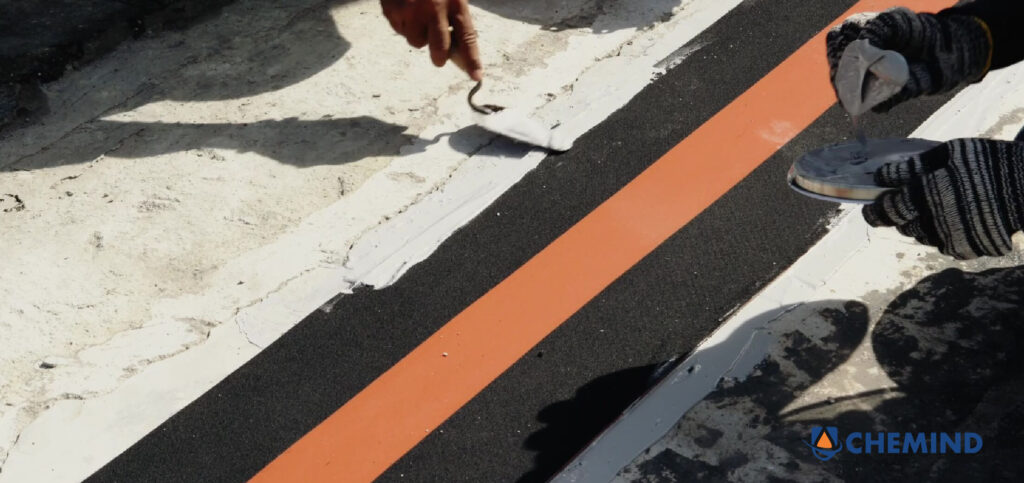
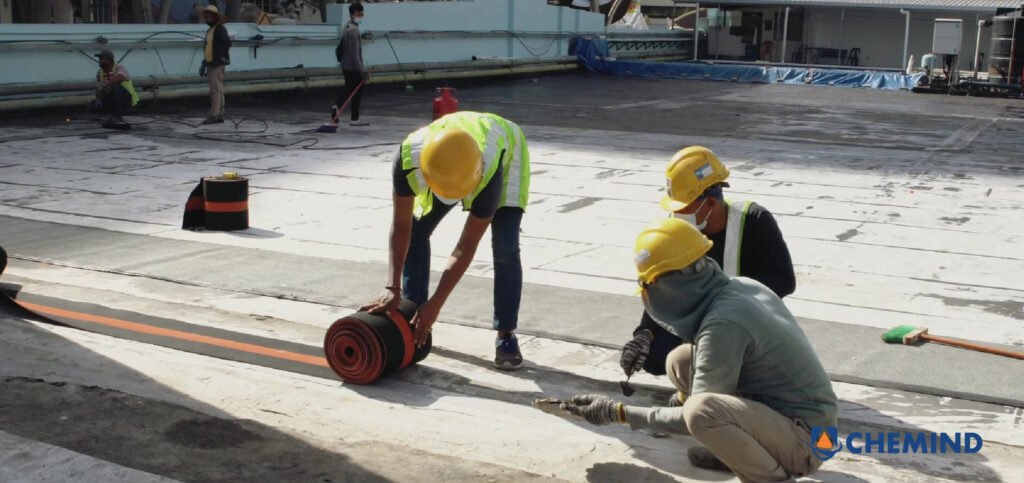
Common reinforcement methods include:
- Polyester reinforcement fabric
- Flexible joint tapes
- Preformed joint systems
- Additional membrane layering
- Mechanical anchoring systems
Without reinforcement, membranes are highly vulnerable to fatigue and tearing over repeated movement cycles.
5. Poor Drainage Design Around Expansion Joints
Even high-performance waterproofing systems can fail when water ponding is ignored.
Horizontal expansion joints on podium decks, rooftops, and parking decks are especially vulnerable because standing water increases hydrostatic pressure and accelerates membrane deterioration.
Proper detailing should include:
- Adequate slope design
- Efficient drainage outlets
- Overflow provisions
- Water diversion detailing
- Termination protection
Waterproofing design should never be separated from drainage planning.
6. Assuming Sealants Alone Are Sufficient
Sealants are important components of expansion joint systems — but they are not complete waterproofing solutions on their own.
Many failures happen when projects rely solely on exposed sealants without secondary waterproofing protection beneath the surface.
Modern expansion joint waterproofing systems often include multiple layers such as:
- Backer rods
- Flexible sealants
- Bond breakers
- Reinforced membranes
- Waterstops
- Protection layers
A redundant waterproofing approach significantly improves long-term durability, especially in critical structures such as basements and podium decks.
Why Expansion Joint Failures Are More Severe in High-Rise Buildings
High-rise buildings face greater movement stress compared to low-rise structures.
Factors include:
- Stronger wind-induced movement
- Larger thermal variation across height
- Longer structural spans
- Greater differential movement
- Increased facade exposure
When waterproofing fails at high elevations, repairs become significantly more expensive due to:
- Rope access requirements
- Scaffold costs
- Tenant disruption
- Water damage to interior finishes
- Structural deterioration risks
Preventive design and proper system specification are therefore far more cost-effective than remedial repairs.
Best Practices for Waterproofing Expansion Joints
To reduce failure risks, engineers and developers should adopt a comprehensive waterproofing strategy that includes:
Early Coordination During Design Stage
Waterproofing specialists should be involved before construction begins, not after leakage occurs.
Movement-Based System Selection
Choose waterproofing systems according to expected joint movement capability.
Compatible Material Systems
Ensure primers, membranes, sealants, and accessories are fully compatible.
Reinforced Waterproofing Detailing
Critical joint areas should always receive reinforcement and proper edge treatment.
Proper Surface Preparation
Substrate contamination, moisture, or uneven surfaces can compromise adhesion.
Maintenance Accessibility
Expansion joints require periodic inspection and maintenance over the building lifecycle.
Chemind Industries’ Approach to Expansion Joint Waterproofing
At Chemind Industries, we focus on waterproofing systems engineered for durability, flexibility, and long-term performance in demanding tropical environments.
Our solutions are designed to support:
- High movement capability
- UV resistance
- Weather durability
- Strong adhesion performance
- Compatibility with multiple substrates
- Long-term waterproofing reliability
Whether for podium decks, rooftops, basements, wet areas, or facade joints, proper detailing and material selection like Flexjoint EP, Flexline and GVK 200 remain critical to preventing costly leakage failures in high-rise developments.
Conclusion
Expansion joints are among the most failure-prone waterproofing areas in high-rise buildings — not because the joints themselves are problematic, but because they are often underestimated during design and construction.
The most common mistakes include:
- Using rigid waterproofing systems
- Ignoring movement calculations
- Poor detailing coordination
- Lack of reinforcement
- Material incompatibility
- Inadequate drainage planning
Successful waterproofing of expansion joints requires a system-based approach that combines engineering coordination, compatible materials, proper detailing, and skilled installation.
For long-term building durability, expansion joint waterproofing should never be treated as an afterthought.